
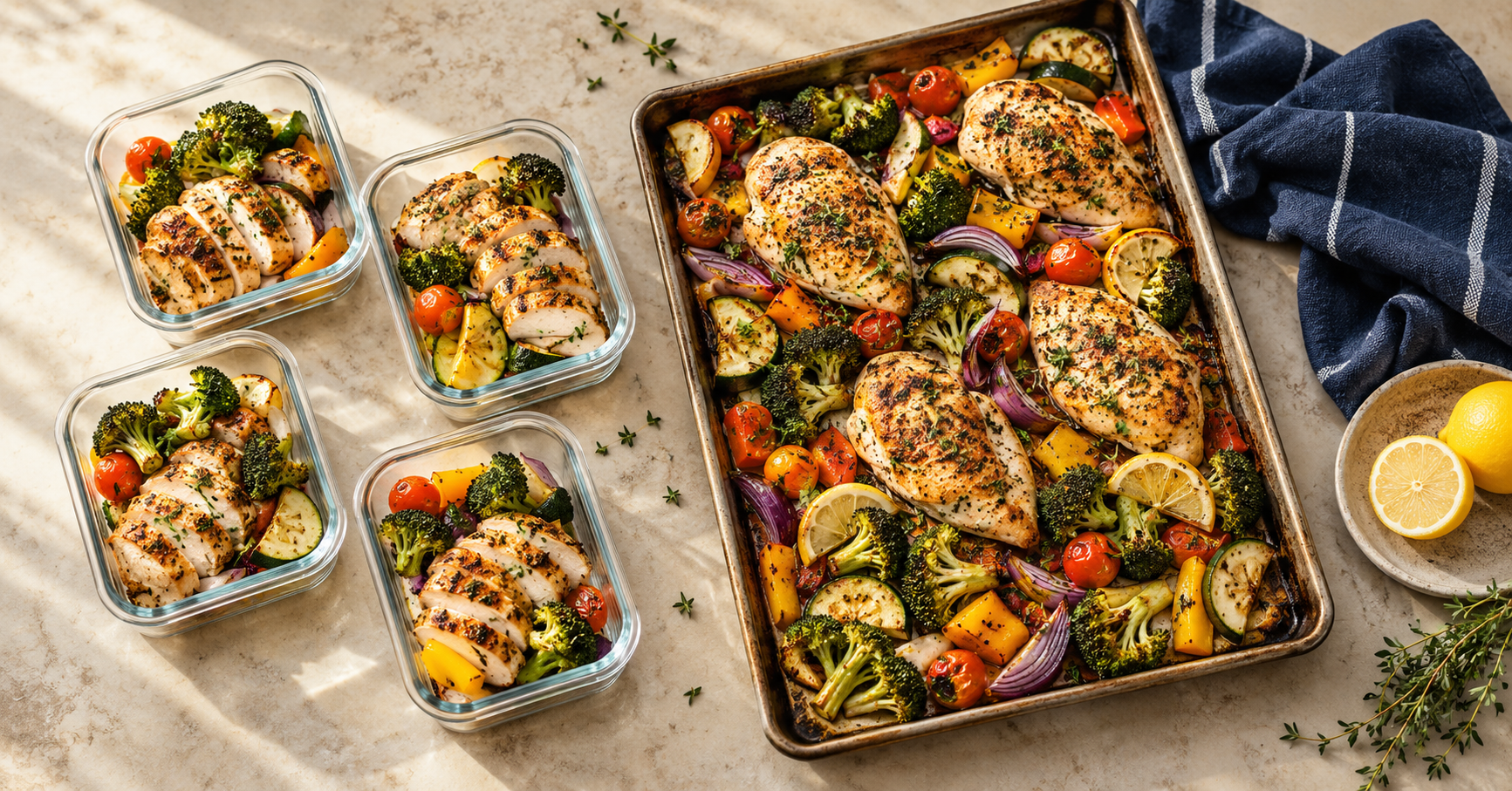
If meal prep keeps falling apart halfway through the week, the answer is not always a stricter plan. Sometimes the recipe made too much. Sometimes the portions did not match your appetite. Sometimes Wednesday arrived and you simply did not want the same meal again.
The point of meal prep is to make lunch easier, not to create another rule you have to follow perfectly. This recipe gives you four lunches from one sheet pan, but it also leaves room to change the flavors, use what you already have, and prepare fewer servings when that fits your week better.
Start with the week you actually have
Before buying ingredients, look at your calendar. Will you be home for lunch four days? Do you have access to a refrigerator and microwave? Is there a work lunch, appointment, or travel day that changes the plan?
If you only need two lunches, make two. If you know you will want more variety, season half the pan one way and half another. A plan that matches your week is more useful than four containers that sit untouched in the refrigerator.
For the basic version below, I am using chicken and vegetables because they can cook together with very little hands-on work. You can add a cooked grain or serve the meal over greens if that fits your preferences. The amounts are a practical starting point, not a prescribed meal plan.
The basic sheet-pan lunch
Makes four lunch containers
Ingredients
- 1 1/2 pounds boneless, skinless chicken breast, cut into similar-size pieces
- About 5 cups chopped vegetables, such as broccoli florets, bell peppers, cauliflower, green beans, or sliced carrots
- 2 tablespoons olive oil
- 1 lemon
- 2 garlic cloves, minced
- 1 teaspoon dried oregano
- 1 teaspoon paprika
- Black pepper to taste
- Salt to taste, if appropriate for you
- Optional for serving: a cooked grain or greens
Directions
- Heat the oven to 425°F. Line a large, rimmed sheet pan with parchment paper or foil for easier cleanup.
- Cut the chicken and vegetables into similar-size pieces. Keep raw chicken and anything that will not be cooked separate, and wash your hands and utensils after handling it. FoodSafety.gov summarizes home food safety in four steps: clean, separate, cook, and chill.[1]
- Mix the olive oil, juice from half the lemon, garlic, oregano, paprika, pepper, and salt if you are using it. Toss the chicken and vegetables with the mixture, then spread everything into a single layer. If the food is piled up, use a second pan rather than crowding it.
- Roast for about 20 to 25 minutes, stirring the vegetables once. Cooking time will vary with the size and type of the ingredients, so do not use the clock as the safety test. Check the thickest pieces of chicken with a food thermometer; poultry should reach 165°F.[2]
- Add a squeeze of lemon after cooking. Divide the meal among four shallow containers, adding a cooked grain or greens if you choose.
You can divide the pan evenly as a starting point without assuming each container must be the right amount for every person. You may want fruit, yogurt, or another side with lunch, or you may find that the container itself is more than you need at one sitting.
Change the meal without starting over
Eating the same flavor four days in a row is where many reasonable meal-prep plans lose their appeal. The easiest fix is to keep the cooking method and change the finish.
Try dividing the cooked food into pairs:
- Add lemon and a spoonful of plain yogurt with herbs to two portions.
- Add salsa and a squeeze of lime to the other two.
- Use a lower-sodium bottled sauce you already enjoy, checking the label if sodium or added sugar is something you monitor.
- Pack sauces separately so the vegetables keep their texture.
You can also change the vegetables. Brussels sprouts, cabbage, zucchini, or seasonal vegetables can replace the original mix. Softer vegetables such as zucchini usually need less time, so add them later. Potatoes and sweet potatoes generally need a head start unless they are cut quite small. If you use frozen vegetables, expect more moisture and allow room on the pan for steam to escape.
For a meatless version, chickpeas or tofu can work with the same general method. Drain and dry chickpeas before roasting. Press and cube firm tofu, then season it before it goes on the pan. These substitutions change the meal’s nutrient profile, so they are choices—not exact nutritional equivalents.
If you substitute another animal protein, use the safe internal temperature for that food rather than assuming the chicken temperature applies. FoodSafety.gov maintains a current chart for poultry, ground meats, whole cuts, seafood, eggs, casseroles, and leftovers.[2]
Portion, cool, and store it safely
Once lunch is cooked, do not leave the full pan on the counter for the afternoon. Place the food into shallow containers and refrigerate it promptly. FoodSafety.gov advises refrigerating perishable food within two hours, or within one hour when it has been exposed to temperatures above 90°F.[1]
Keep the refrigerator at 40°F or below. Cooked leftovers should be used within four days, and reheated leftovers should reach 165°F.[3] A Sunday preparation can therefore cover Monday through Thursday when it has been handled and refrigerated safely. If your fourth lunch would fall outside that window, freeze it sooner instead of leaving it in the refrigerator longer.
Labeling the containers with the preparation date helps. So does putting tomorrow’s lunch where you can see it. If you do not know how long a perishable meal sat at room temperature, follow the time limits above rather than guessing.
When a general recipe is not enough
This is a flexible lunch idea, not an individualized nutrition prescription. The portion, ingredients, and sides that make sense for you may depend on your health history, medications, allergies, cultural preferences, food budget, symptoms, and goals.
A general recipe cannot account for all of that. NIDDK advises looking for an eating plan tailored to a person’s health, cultural needs, preferences, and values. It also recommends discussing medical conditions, medications, and supplements with a health professional when evaluating a weight-management plan.[4]
If a medication has changed your appetite, if certain foods have become difficult to tolerate, or if you are managing a condition that affects what or how much you should eat, bring that information to your provider. The solution may not be to force yourself through four identical portions. It may be to change the amount, texture, timing, ingredients, or the entire meal idea.
Useful questions to bring to a visit include:
- Does this lunch fit the nutrition guidance you have given me?
- Should I adjust the portion or add something to it?
- Are there ingredients I should limit or avoid because of a condition or medication?
- What can I use when my appetite or tolerance changes?
- Would a registered dietitian be helpful for my needs?
Meal prep does not have to cover every meal to be worthwhile. One pan and two useful lunches may solve more of the week than an ambitious plan you do not want to repeat. Start with the number of meals you will realistically use, store them safely, and adjust from what you learn.
If you would like help fitting everyday food decisions into a medical weight-management plan, bring your questions to a MEDY visit. We can look at the broader picture—your health, current treatment, preferences, and daily life—before deciding what makes sense for you.
For broader guidance on building flexible eating habits, read How to Lose Weight Without Counting Calories and explore MEDY's medical weight-loss program.
Sources
- 4 Steps to Food Safety. FoodSafety.gov, U.S. Department of Health and Human Services. https://www.foodsafety.gov/keep-food-safe/4-steps-to-food-safety. Accessed September 8, 2026.
- Cook to a Safe Minimum Internal Temperature. FoodSafety.gov, U.S. Department of Health and Human Services. https://www.foodsafety.gov/food-safety-charts/safe-minimum-internal-temperatures. Accessed September 8, 2026.
- People at Risk of Food Poisoning. FoodSafety.gov, U.S. Department of Health and Human Services. Subsection: “Store Your Leftovers Safely.” https://www.foodsafety.gov/people-at-risk. Accessed September 8, 2026.
- Choosing a Safe & Successful Weight-loss Program. National Institute of Diabetes and Digestive and Kidney Diseases, National Institutes of Health. https://www.niddk.nih.gov/health-information/weight-management/choosing-a-safe-successful-weight-loss-program. Accessed September 8, 2026.